Page023
Entrapment and Enticement
Another topic closely related to the involvement of law enforcement in the investigative process deals with the concepts of entrapment and enticement. Entrapment is when law enforcement, or an agent of law enforcement, persuades someone to commit a crime when the person otherwise had no intention to commit a crime. Entrapment can serve as a legal defense in a court of law, and, therefore, should be avoided if prosecution is a goal. A closely related concept is enticement. Enticement could still involve agents of law enforcement making the conditions for commission of a crime favorable, but the difference is that the person is determined to have already broken a law or is intent on doing so. The question as to whether the actions of law enforcement will constitute enticement or entrapment is ultimately up to a jury. Care should be taken to distinguish between these two terms.
Computer Crime
One aspect of the interaction between information security and the legal system is that of computer crimes. Applicable computer crime laws vary throughout the world, according to jurisdiction. However, regardless of region, some generalities exist. Computer crimes can be understood as belonging loosely to three different categories based upon the way in which computer systems relate to the wrongdoing: computer systems as targets; computer systems as a tool to perpetrate the crime; or computer systems involved but incidental. The last category occurs commonly because computer systems are such an indispensable component of modern life. The other two categories are more significant:
- Computer systems as a target—Crimes where the computer systems serve as a primary target, such as: disrupting online commerce by means of Distributed Denial of Service attacks, installing malware on systems for the distribution of spam, or exploiting a vulnerability on a system to leverage it to store illegal content.
- Computer as a tool—Crimes where the computer is a central component enabling the commission of the crime. Examples include: stealing trade secrets by compromising a database server, leveraging computers to steal cardholder data from payment systems, conducting computer-based reconnaissance to target an individual for information disclosure or espionage, and using computer systems for the purposes of harassment.
As information systems have evolved, and as our businesses now leverage computer systems to a larger extent, traditional crimes such as theft and fraud are being perpetrated both by using and targeting computers. One of the most difficult aspects of prosecution of computer crimes is attribution. Meeting the burden of proof requirement in criminal proceedings, beyond a reasonable doubt, can be difficult given an attacker can often spoof the source of the crime or can leverage different systems under someone else’s control.
Intellectual Property
As opposed to physical or tangible property, intellectual property refers to intangible property that results from a creative act. The purpose of intellectual property law is to control the use of intangible property that can often be trivial to reproduce or abuse once made public or known. The following intellectual property concepts effectively create an exclusive monopoly on their use.
Trademark
Trademarks are associated with marketing: the purpose is to allow for the creation of a brand that distinguishes the source of products or services. A distinguishing name, logo, symbol, or image represents the most commonly trademarked items. In the United States two different symbols are used with distinctive marks that an individual or organization intends to protect. The superscript TM symbol can be used freely to indicate an unregistered mark, and is shown in Fig. 2.6.
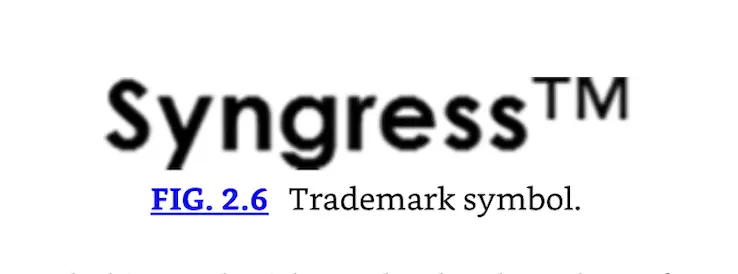 Trademark symbol.
The circle R symbol is used with marks that have been formally registered as a trademark with the U.S. Patent and Trademark Office, and is shown in Fig. 2.7. In addition to the registered and unregistered version of a trademark, servicemarks constitute a subset of brand recognition related intellectual property. As suggested by the name, a servicemark is used to brand a service offering rather than a particular product or company, and looks like the unregistered trademark, being denoted by a superscript SM symbol.
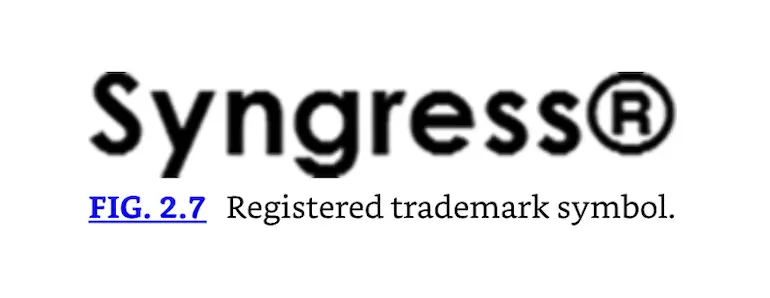 Registered trademark symbol.