Page164
ABCD Fires and Suppression
The primary safety issue in case of fire is safe evacuation. Fire suppression systems are used to extinguish fires, and different types of fires require different suppressive agents. These systems are typically designed with personnel safety as the primary concern. See Fig. 4.38 for a summary of fire class symbols used in the United States.
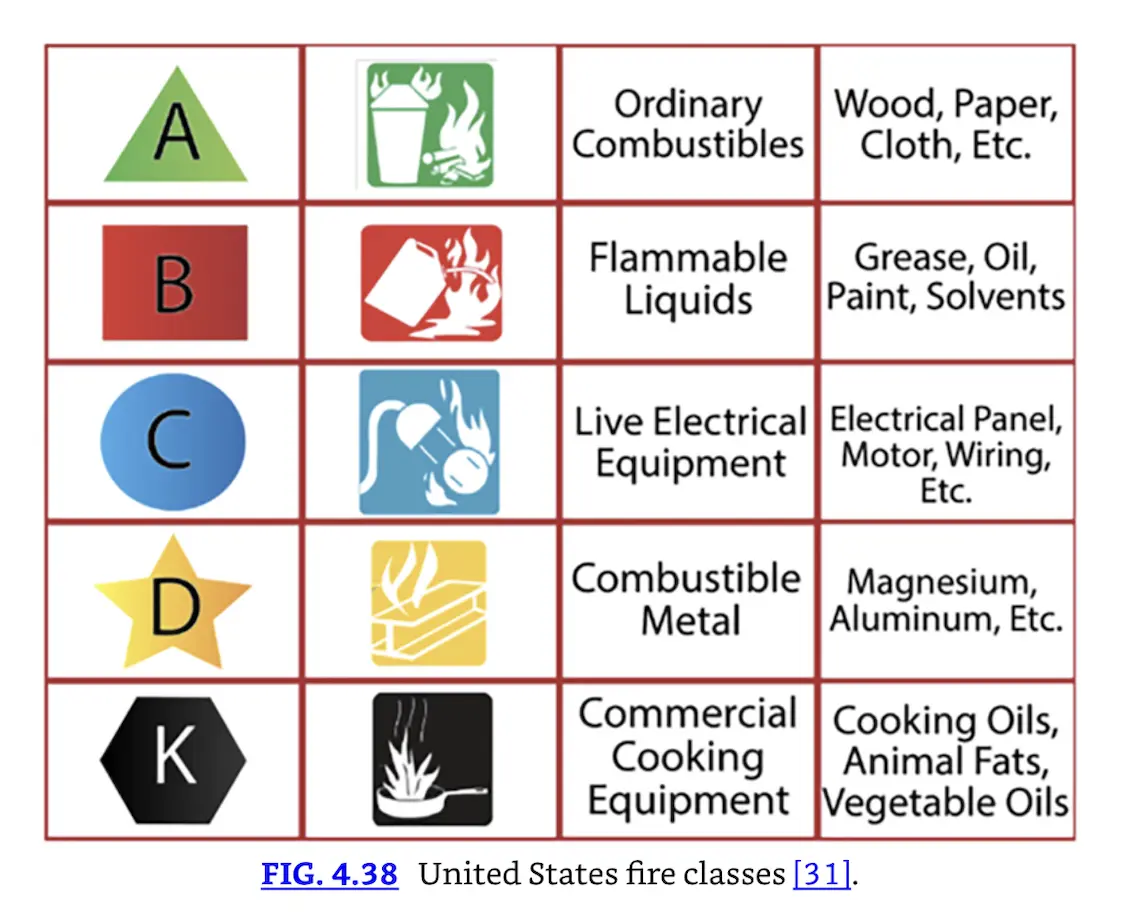
Fig. 4.38 United States fire classes [31].
Classes of Fire and Suppression Agents
Class A fires are common combustibles such as wood, and paper. This type of fire is the most common and should be extinguished with water or soda acid.
Class B fires are burning alcohol, oil, and other petroleum products such as gasoline. They are extinguished with gas or soda acid. You should never use water to extinguish a class B fire.
Class C fires are electrical fires that are fed by electricity and may occur in equipment or wiring. Electrical fires are Conductive fires, and the extinguishing agent must be non-Conductive, such as any type of gas. Many sources erroneously list soda acid as recommended for class C fires: this is incorrect, as soda acid can conduct electricity.
Class D fires are burning metals and are extinguished with dry powder.
Class K fires are kitchen fires, such as burning oil or grease. Wet chemicals are used to extinguish class K fires.
Note
This section refers to the National Fire Protection Agency (NFPA) fire code conventions, primarily used in the United States. Other countries have other conventions. For example, Europe’s system models the US for class A and B and D fires, but considers flammable gases as class C fires, electrical fires as class E fires, and kitchen fires as class F. See Table 4.13 for a comparison. The NFPA’s site is https://www.nfpa.org. European fire classes are discussed here: https://www.firesafe.org.uk/portable-fire-extinguisher-general/.Table 4.13 Classes of Fire and Suppression Agents.
US Class Europe Class Material Suppression Agent A A Ordinary combustibles such as wood and paper Water or soda acid B B Liquid Halon/Halon substitute, CO₂, or soda acid B C Flammable gases Halon/Halon substitute, CO₂, or soda acid C E Electrical equipment Halon/Halon substitute, CO₂ D D Combustible metals Dry powder K F Kitchen (oil or fat) fires Wet chemicals Exam Warning
The CISSP® exam is an international exam. Always beware of questions that may be answered differently based on location: make sure you give the best answer to the question (and not the answer for your given locale). Names for types of fires are one example; others include laws, and metric measures such as meters versus American/imperial measures such as yards.