Page177
Quality of Service
Making unused bandwidth available for other applications presents a challenge: what happens when all bandwidth is consumed? Which applications “win” (receive required bandwidth)? This is not an issue with circuit-switched networks, where applications have exclusive access to dedicated circuits or channels.
Packet-switched networks may use Quality of Service (QoS) to give specific traffic precedence over other traffic. For example: QoS is often applied to Voice over IP (VoIP) traffic (voice via packet-switched data networks), to avoid interruption of phone calls. Less time-sensitive traffic, such as SMTP (Simple Mail Transfer Protocol, a store-and-forward protocol used to exchange email between servers), often receives a lower priority. Small delays in exchanging emails are less likely to be noticed compared to dropped phone calls.
Layered Design
Network models such as OSI and TCP/IP are designed in layers. Each layer performs a specific function, and the complexity of that functionality is contained within its layer. Changes in one layer do not directly affect another: changing your physical network connection from wired to wireless (at Layer 1, as described below) has no effect on your Web browser (at Layer 7), for example.
Models and Stacks
A network model is a description of how a network protocol suite operates, such as the OSI Model or TCP/IP Model. A network stack is a network protocol suite programmed in software or hardware. For example, the TCP/IP Model describes TCP/IP, and your laptop runs the TCP/IP stack.
The OSI Model
The OSI (Open System Interconnection) Reference Model is a layered network model. The model is abstract: we do not directly run the OSI model in our systems (most now use the TCP/IP model); it is used as a reference point, so “Layer 1” (physical) is universally understood, whether you are running Ethernet or ATM, for example. “Layer X” in this book refers to the OSI model.
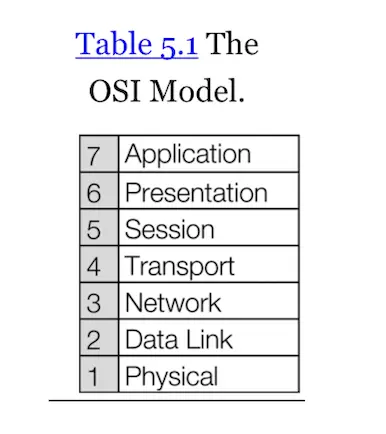
The OSI model has seven layers, as shown in Table 5.1. The layers may be listed in top-to-bottom or bottom-to-top order. Using the latter, they are Physical, Data Link, Network, Transport, Session, Presentation, and Application.
Note
The OSI model was developed by the International Organization for Standardization (ISO), so some sources confusingly call it the ISO model, or even the ISO OSI model. The model is formally called “X.200: Information technology—Open Systems Interconnection—Basic Reference Model.”
The X.200 recommendation may be downloaded for free at https://www.itu.int/rec/T-REC-X.200-199407-I/en. The term “OSI model” is the most prevalent, so that is the term used in this book.