Page179
Layer 6—Presentation
The Presentation Layer presents data to the application (and user) in a comprehensible way. Presentation Layer concepts include data conversion, character sets such as ASCII, and image formats such as GIF (Graphics Interchange Format), JPEG (Joint Photographic Experts Group), and TIFF (Tagged Image File Format).
Layer 7—Application
The Application Layer is where you interface with your computer application. Your Web browser, word processor, and instant messaging client exist at Layer 7. The protocols Telnet and FTP are Application Layer protocols.
Note
Many mnemonics exist to help remember the OSI model. From bottom to top, “Please Do Not Throw Sausage Pizza Away” (Physical Data-Link Network Transport Session Presentation Application) is a bit silly, but that makes it more memorable. Also silly: “Please Do Not Tell Sales People Anything.” From top to bottom, “All People Seem To Need Data Processing” is also popular.
The TCP/IP Model
The TCP/IP model (Transmission Control Protocol/Internet Protocol) is a popular network model created by DARPA in the 1970s (see https://www.internetsociety.org/internet/history-internet/brief-history-internet/ for more information). TCP/IP is an informal name (named after the first two protocols created); the formal name is the Internet Protocol Suite. The TCP/IP model is simpler than the OSI model, as shown in Table 5.2.
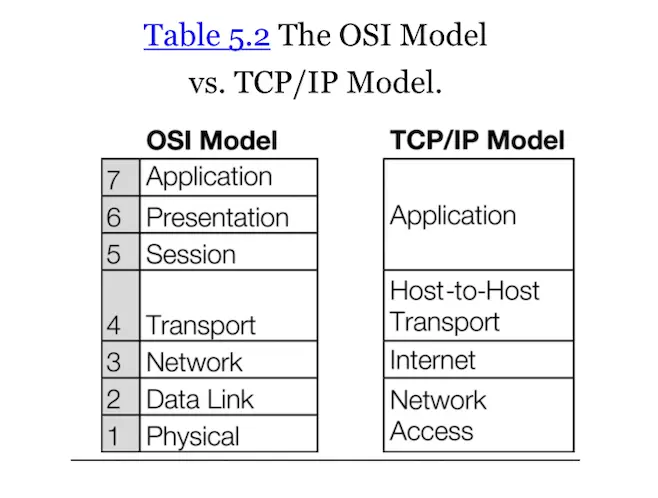
While TCP and IP receive top billing, TCP/IP is actually a suite of protocols including UDP (User Datagram Protocol) and ICMP (Internet Control Message Protocol), among many others.
Note
The names and number of the TCP/IP layers are a subject of much debate, with many “authoritative” sources disagreeing with each other. Confusingly, some sources use Link Layer in place of Network Access Layer, and Network layer in place of Internet Layer. This book follows the conventions described in TCP/IP references listed in the exam’s Candidate Information Bulletin, such as Cisco TCP/IP Routing Professional Reference (McGraw-Hill) by Chris Lewis.
Network Access Layer
The Network Access Layer of the TCP/IP model combines Layers 1 (Physical) and 2 (Data Link) of the OSI model. It describes Layer 1 issues such as energy, bits, and the medium used to carry them (copper, fiber, wireless, etc.). It also handles MAC (Media Access Control) addresses, used to deliver data to the correct device on a network.
describes Layer 2 issues such as converting bits into protocol units such as Ethernet frames, MAC (Media Access Control) addresses, and Network Interface Cards (NICs).