Page198
Coaxial Cabling
A coaxial network cable, shown in Fig. 5.13, has an inner copper core (marked “D”) separated by an insulator (marked “C”) from a metallic braid or shield (marked “B”). The outer layer is a plastic sheath (marked “A”). The insulator prevents the core from touching the metallic shield, which would create an electrical short. Coaxial cables are often used for satellite and cable TV service.
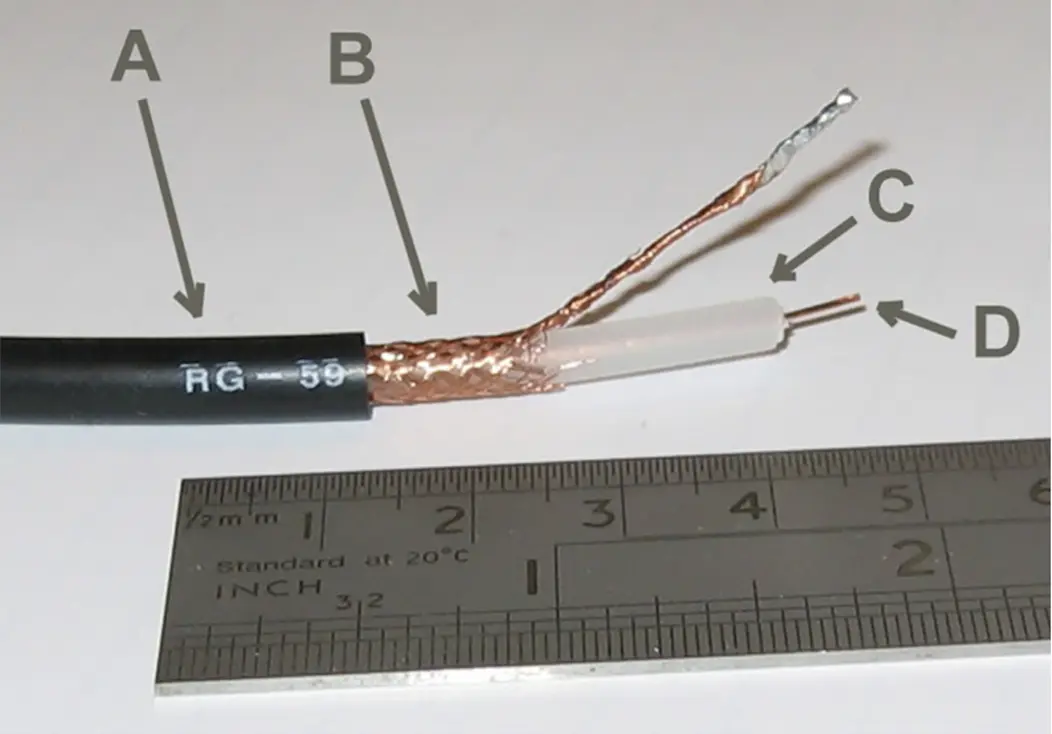 Coaxial cable. Source: https://commons.wikimedia.org/wiki/File:RG-59.jpg. Image by Arj. Image under permission of Creative Commons.

The core and shield used by coaxial cable are thicker and better insulated than other cable types, such as twisted pair. This makes coaxial more resistant to EMI and allows higher bandwidth and longer connections compared with twisted pair cable.
Two older types of coaxial cable are Thinnet and Thicknet, used for Ethernet bus networking.
Fiber Optic Network Cable
Fiber Optic network cable (simply called “fiber”) uses light to carry information,
which can carry a tremendous amount of information. Fiber can be used to transmit via long distances: past 50 miles, much further than any copper cable such as twisted pair or coaxial. Fiber’s advantages are speed, distance, and immunity to EMI. Disadvantages include cost and complexity.
Multimode fiber carrier uses multiple modes (paths) of light, resulting in light dispersion. Single-mode fiber uses a single strand of fiber, and the light uses one mode (path) down the center of the fiber. Multimode fiber is used for shorter distances; single-mode fiber is used for long haul, high-speed networking.
Multiple signals may be carried via the same fiber via the use of Wavelength Division Multiplexing (WDM), where multiple light “colors” are used to transmit different channels of information via the same fiber. Combined speeds of over a terabit/second can be achieved when WDM is used to carry 10 gigabits per color.