Page200
LAN Physical Network Topologies
Physical Network Topologies describe Layer 1 locally: how the cables are physically run. There have been many popular physical topologies over the years; many, such as the bus and ring, have faded as the star topology has become dominant.
Legacy LAN Topologies
A physical bus connected network nodes in a string. Each node inspected the data as it passed along the bus. Ethernet Thinnet and Thicknet were bus technologies. A physical ring connected network nodes in a ring: if you followed the cable from node to node, you would finish where you began. FDDI (Fiber Distributed Data Interface) was a LAN ring technology. All are considered legacy LAN technologies that have been overtaken by star.
Star
Star topology has become the dominant physical topology for LANs. The star was adopted by Ethernet (which originally supported bus only). Each node is connected directly to a central device such as a hub or a switch, as shown in Fig. 5.14.
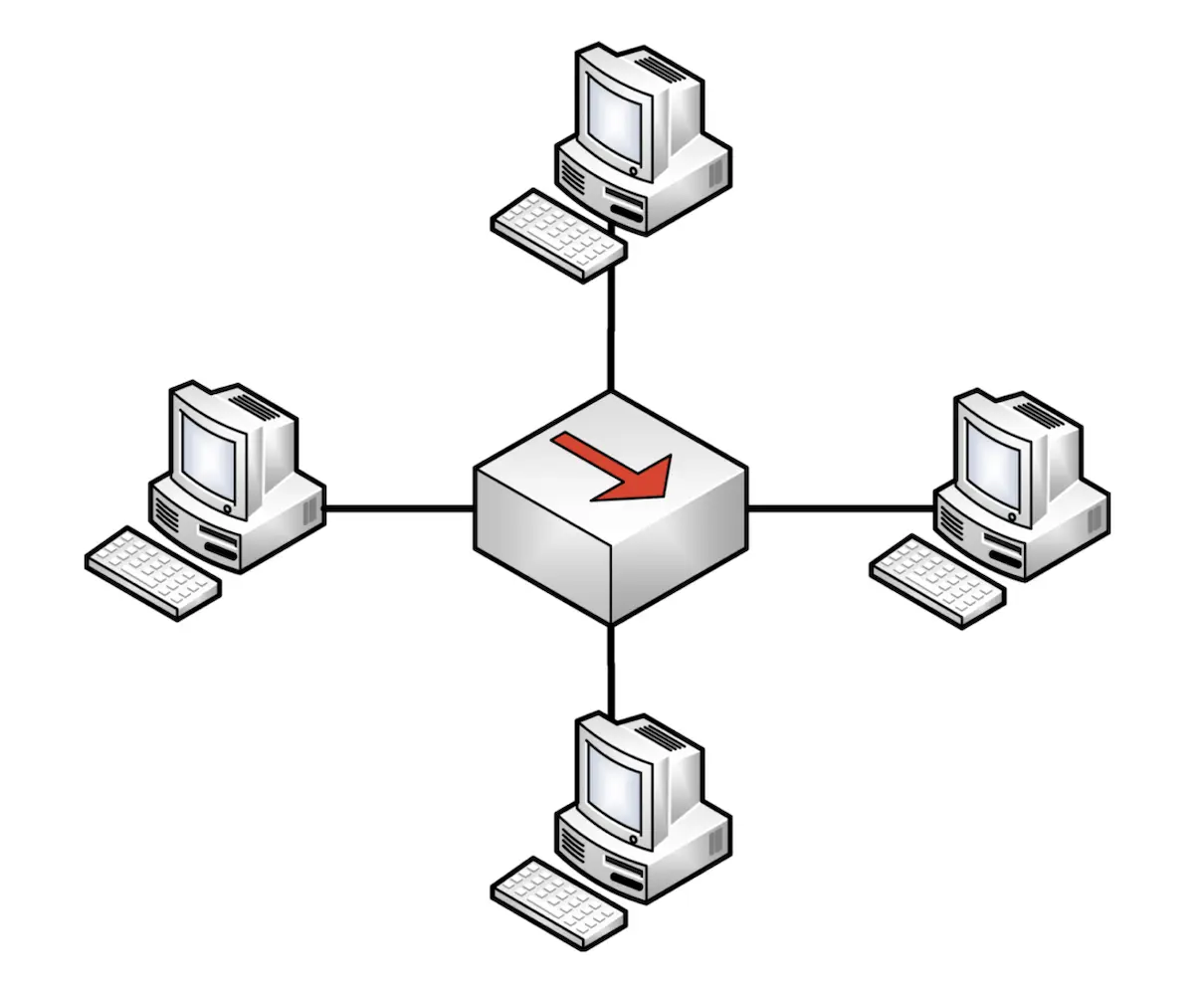 Star topology.
Stars feature better fault tolerance: any single local cable cut or NIC failure affects one node only. Since each node is wired back to a central point, more cable is required as opposed to bus (where one cable run connects nodes to each other). This cost disadvantage is usually outweighed by the fault tolerance advantages.