Page201
Mesh
A mesh interconnects network nodes to each other. Fig. 5.15 shows two mesh networks. The left mesh is fully connected, with four Web servers interconnected. The right mesh is partially connected: each node has multiple connections to the mesh, but every node does not connect to every other.
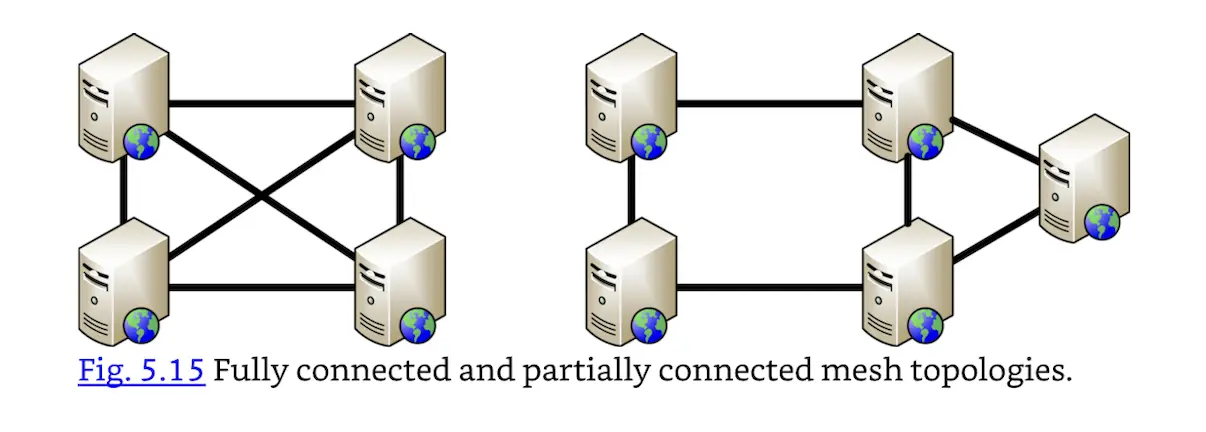 Fully connected and partially connected mesh topologies.
Meshes have superior availability and are often used for highly available (HA) server clusters. Each of the four Web servers shown on the left in can share the load of Web traffic and maintain state information between each other. If any Web server in the mesh goes down, the others remain up to shoulder the traffic load.
WAN Technologies and Protocols
ISPs and other “long-haul” network providers, whose networks span from cities to countries, often use Wide Area Network technologies. Many of us have hands-on experience configuring LAN technologies such as connecting Cat5 network cabling; it is less common to have hands-on experience building WANs.
T1s, T3s, E1s, E3s
There are several international circuit standards: the most prevalent are T Carriers (United States) and E Carriers (Europe). A T1 is a dedicated 1.544-megabit circuit that carries twenty-four 64-bit DS0 (Digital Signal 0) channels (such as 24 circuit-switched phone calls). Note that the terms DS1 (Digital Signal 1) and T1 are often used interchangeably. DS1 describes the flow of bits (via any medium, such as copper, fiber, and wireless); a T1 is a copper telephone circuit that carries a DS1.
A T3 is 28 bundled T1s, forming a 44.736-megabit circuit. The terms T3 and DS3 (Digital Signal 3) are also used interchangeably, with the same T1/DS1 distinction noted above. E1s are dedicated 2.048-megabit circuits that carry 30 channels, and 16 E1s form an E3, at 34.368 megabits.
Note
T1 and T3 speeds are often rounded off to 1.5 and 45 megabits, respectively. This book will use those numbers (and they are also good shorthand for the exam). Beyond the scope of the exam is the small amount of bandwidth required for circuit framing overhead. This is the reason 28 T1s times 1.544 megabits equals 43.232 megabits, a bit lower than the T3 speed of 44.736 megabits. The same is true for the E1 -> E3 math.
SONET (Synchronous Optical Networking) carries multiple T-carrier circuits via fiber optic cable. SONET uses a physical fiber ring for redundancy.