Page211
Cellular Networks
Cellular networks use cellphone towers (aka “cells”) to connect to cellular devices (such as cellphones) wirelessly. The cells are connected to each other (and to the Internet) via high-speed wired connections. Current cellular technologies include 4G (fourth generation) and 5G (fifth generation). Note that 4G uses macrocells, and 5G uses small cells (which, as the name implies, are smaller). Small cells can be placed on objects such as streetlights.
The primary differences between 4G and 5G are download speed and latency. Download speed describes how many gigabits may be transferred per second. Latency describes the delay (or lag) before data is received. When compared with wired networks, cellular networks historically had low download speeds and high latency. 5G offers 10–20 times the download speed when compared with 4G, with much lower latency. Fig. 5.17, from the United States General Account Office (GAO), shows the major differences between 4G and 5G.
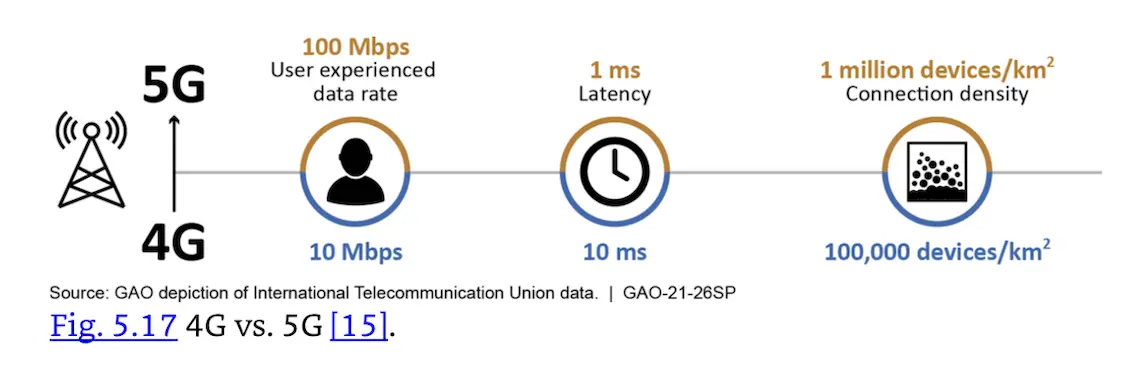 4G vs. 5G [15].
Satellite
Satellite communications provide voice and data services via geostationary satellites that match the Earth’s orbit and appear to be stationary in the sky. Satellite communications are often used in areas that lack broadband Internet or cellphone services, such as rural areas. While satellite communications can provide high download speeds, latency is much higher when compared with wired or cellular networks due to the distance traveled to/from the satellite:
“Radio waves sent from a satellite are moving at the speed of light, but because of the greater distances the signal must travel, the latency is higher than that of terrestrial providers. A cable internet signal, for example, may have an average latency of 30 milliseconds (ms), while a signal from a satellite in geostationary orbit might be 600 ms” [16].