Page217
RIP
RIP (Routing Information Protocol) is a distance vector routing protocol that uses hop count as its metric. RIP will route traffic from Office A to Office B in Fig 5.21 via the direct T1, since it is the “closest” route at 1 hop.
RIP does not have a full view of a network: it can only “see” directly connected routers. Convergence is slow. RIP sends routing updates every 30 seconds, regardless of routing changes. RIP routers that are on a network that is converged for weeks will send routing updates every 30 seconds, around the clock.
RIP’s maximum hop count is 15; 16 is considered “infinite.” RIPv1 can route classful networks only; RIPv2 added support for CIDR. RIP is used by the UNIX routed command and is the only routing protocol universally supported by UNIX.
RIP uses split horizon to help avoid routing loops. In the circuit between the NYC and BOS routers has gone down. At that moment, the NYC and BOS routers know the circuit is down; the other routers do not. The network lacks convergence.
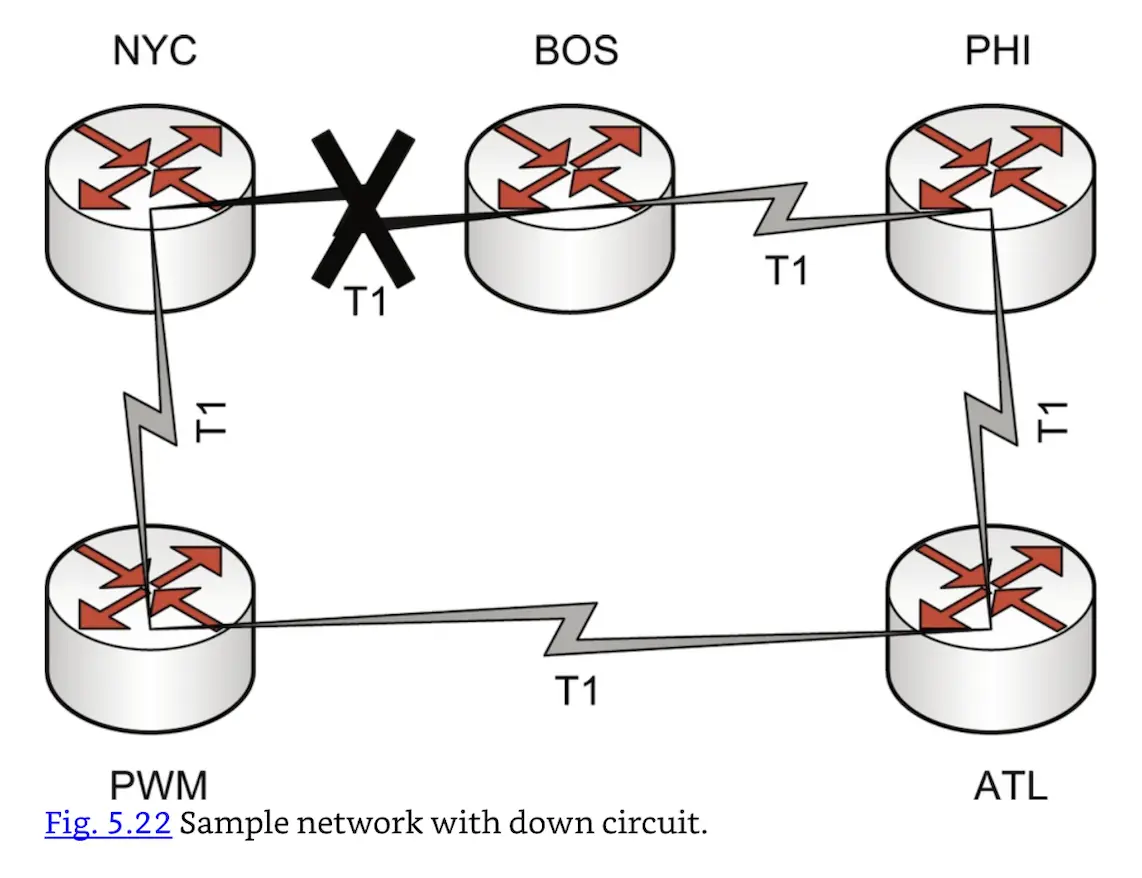 Sample network with down circuit.
NYC tells the PWM router “The route between NYC and BOS is down.” On PWM’s other interface, the ATL router may claim that the link is up. Split horizon means the PWM router will not “argue back”: it will not send a route update via an interface it learned the route from. In our case, the PWM router will not send a NYC → BOS routing update to the NYC router. Poison reverse is an addition to Split Horizon: instead of sending nothing to NYC regarding the NYC → BOS route, PWM sends NYC a NYC → BOS route with a cost of 16 (infinite). NYC will ignore any “infinite” route.
RIP uses a hold-down timer to avoid “flapping” (repeatedly changing a route’s status from up to down). Once RIP changes a route’s status to “down,” RIP will “hold” to that decision for 180 seconds. In Fig. 5.22, the PWM router will keep the NYC → BOS route “down” for 180 seconds. The hope is that the network will have reached convergence during that time. If not, after 180 seconds, RIP may change the status again.
RIP is quite limited. Each router has a partial view of the network and each sends updates every 30 seconds, regardless of change. Convergence is slow. Hold-down timers, Split Horizon, and Poison Reverse are small fixes that do not compensate for RIP’s weaknesses. Link State routing protocols such as OSPF are superior.