Page319
RAID 0—Striped Set
As suggested by the title, RAID 0 employs striping to increase the performance of reads and writes. By itself, striping offers no data redundancy, so RAID 0 is a poor choice if recovery of data is the reason for leveraging RAID. Fig. 8.15 shows visually what RAID 0 entails.
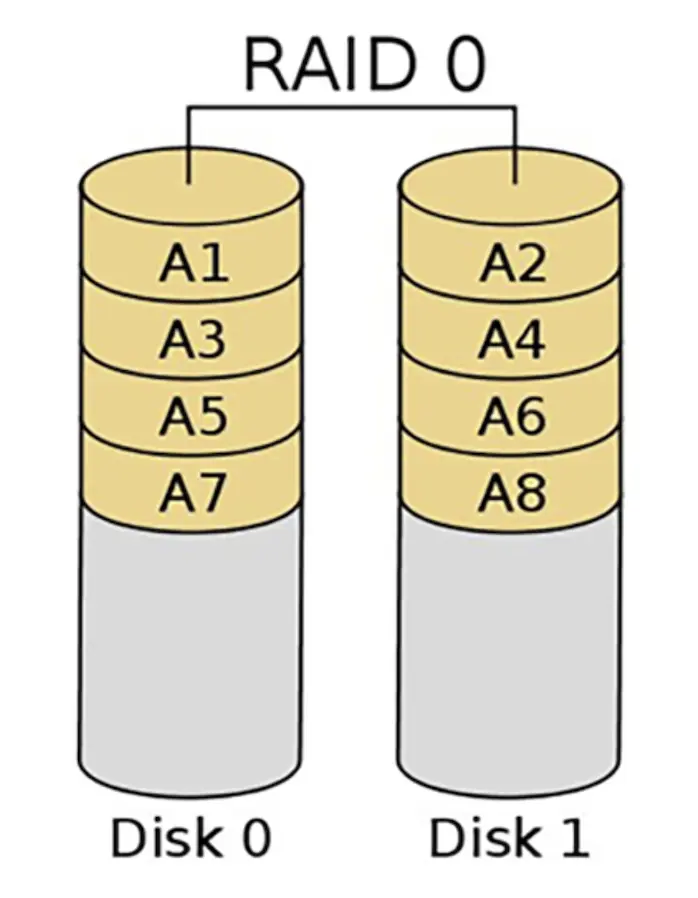 RAID 0—striped set.
RAID 1—Mirrored Set
This level of RAID is perhaps the simplest of all RAID levels to understand. RAID 1 creates/writes an exact duplicate of all data to an additional disk. The write performance is decreased, though the read performance can see an increase. Disk cost is one of the most troubling aspects of this level of RAID, as at least half of all disks are dedicated to redundancy. Fig. 8.16 shows RAID 1 visually.
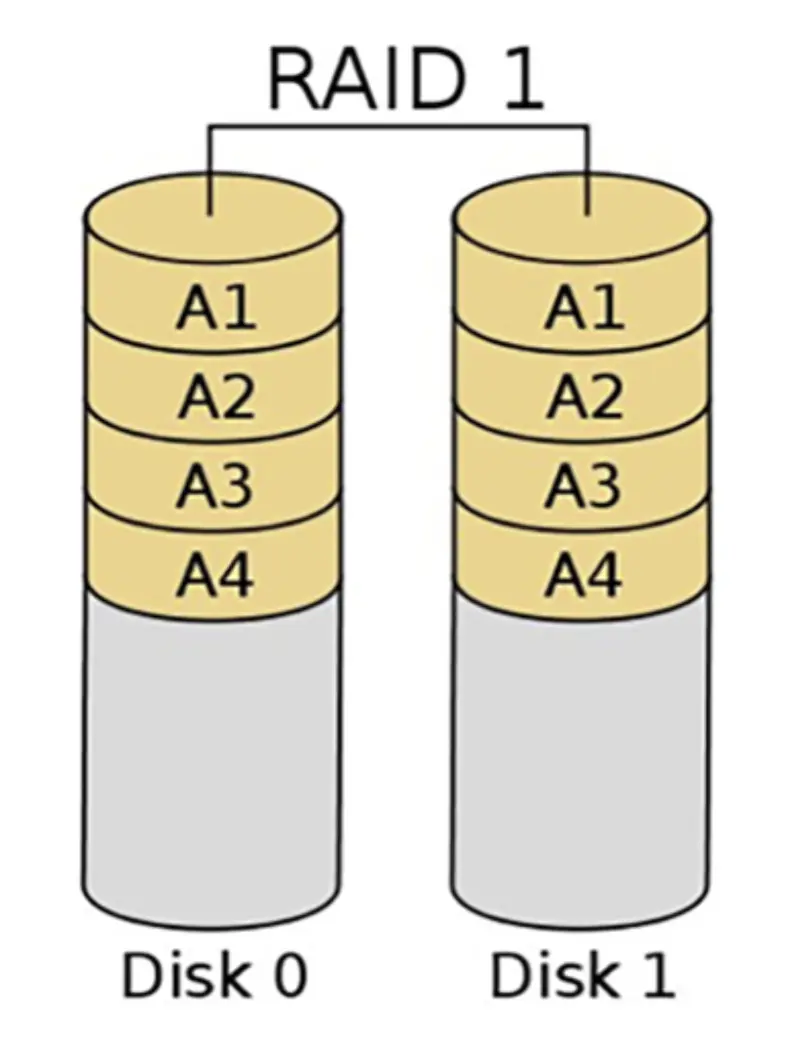 RAID 1 - mirrored set.
RAID 2—Hamming Code
RAID 2 is not considered commercially viable for hard disks and is not used. This level of RAID would require either 14 or 39 hard disks and a specially designed hardware controller, which makes RAID 2 incredibly cost prohibitive. RAID 2 is not likely to be tested.
RAID 3—Striped Set With Dedicated Parity (Byte Level)
Striping is desirable due to the performance gains associated with spreading data across multiple disks. However, striping alone is not as desirable due to the lack of redundancy. With RAID 3, data, at the byte level, is striped across multiple disks, but an additional disk is leveraged for storage of parity information, which is used for recovery in the event of a failure.
RAID 4—Striped Set With Dedicated Parity (Block Level)
RAID 4 provides the exact same configuration and functionality as RAID 3, but stripes data at the block, rather than byte, level. Like RAID 3, RAID 4 employs a dedicated parity drive.
RAID 5—Striped Set With Distributed Parity
One of the most popular RAID configurations is RAID 5, Striped Set with Distributed Parity. Again with RAID 5 there is a focus on striping for the performance increase it offers, and RAID 5 leverages block level striping. Like RAIDs 3 and 4, RAID 5 writes parity information that is used for recovery purposes. However, unlike RAIDs 3 and 4, which require a dedicated disk for parity, RAID 5 distributes the parity data across all of the disks in the array. This distribution allows for recovery from a single disk failure while providing better disk utilization compared to RAID 1.
parity information, RAID 5 distributes the parity information across multiple disks. One of the reasons for RAID 5’s popularity is that the disk cost for redundancy is lower than that of a Mirrored set. Another important reason for this level’s popularity is the support for both hardware- and software-based implementations, which significantly reduces the barrier to entry for RAID configurations. RAID 5 allows for data recovery in the event that any one disk fails. Fig. 8.17 provides a visual representation of RAID 5.
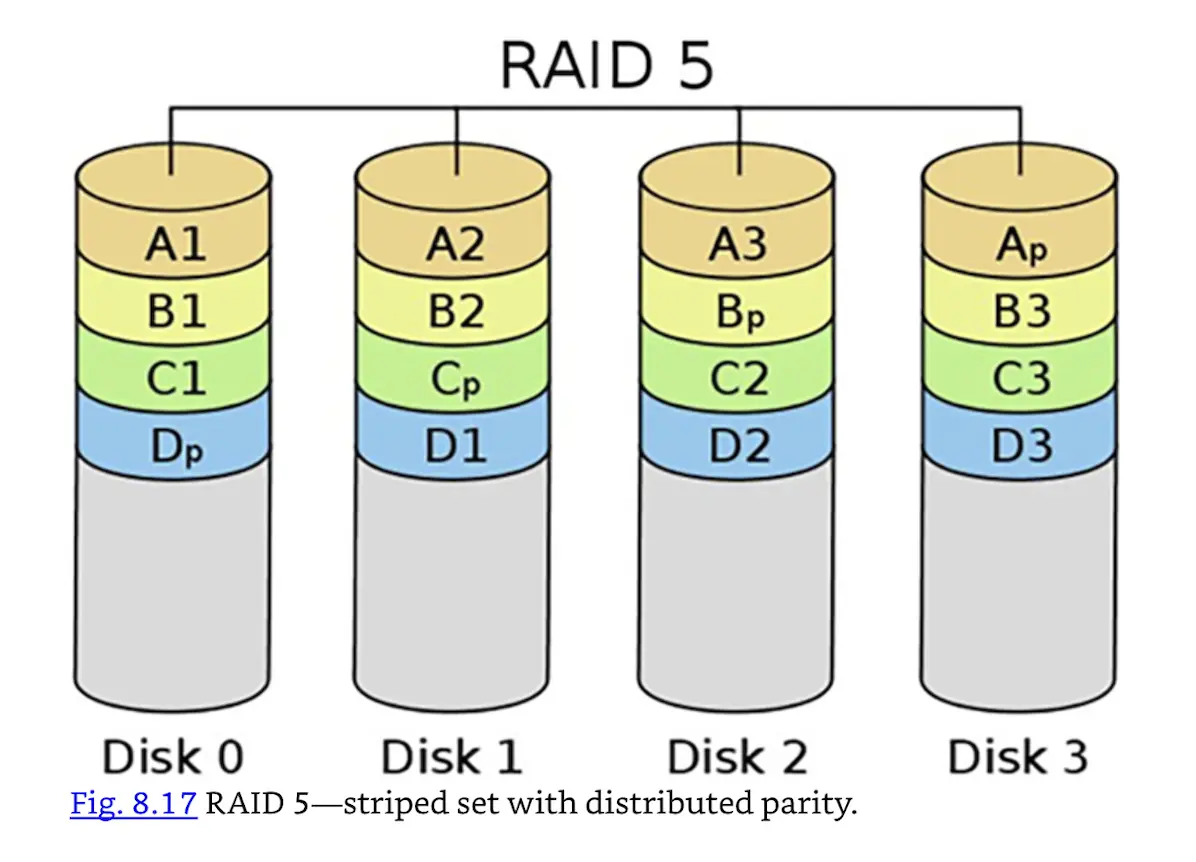 RAID 5 - striped set with distributed parity.