Page344
Call Trees
A key tool leveraged for staff communication by the Crisis Communications Plan is the Call Tree, which is used to quickly communicate news throughout an organization without overburdening any specific person. The call tree works by assigning each employee a small number of other employees they are responsible for calling in an emergency event. For example, the organization president may notify his board of directors of an emergency situation and they, in turn, will notify their top tier managers. The top tier managers will then call the people they have been assigned to call. The call tree continues until all affected personnel have been contacted.
The call tree is most effective when there is a two-way reporting of successful communication. For example, each member of the board of directors would report back to the president when each of their assigned call tree recipients had been contacted and had made contact with their subordinate personnel. Remember that cell phones and landlines may become congested or unusable during a disaster: the call tree should contain alternate contact methods in case the primary methods are unavailable.
Call trees work best when planned for in advance and drilled at least once per year. Phone numbers change, employees change positions, and contact information becomes out of date. A routine drill along with documented procedures and reporting chains keeps the call tree’s functionality at the optimum level. Fig. 8.21 illustrates a typical call tree. In this example, a high-level manager activates the call tree, calling three front line managers. Each front line manager calls the employees they are responsible for.
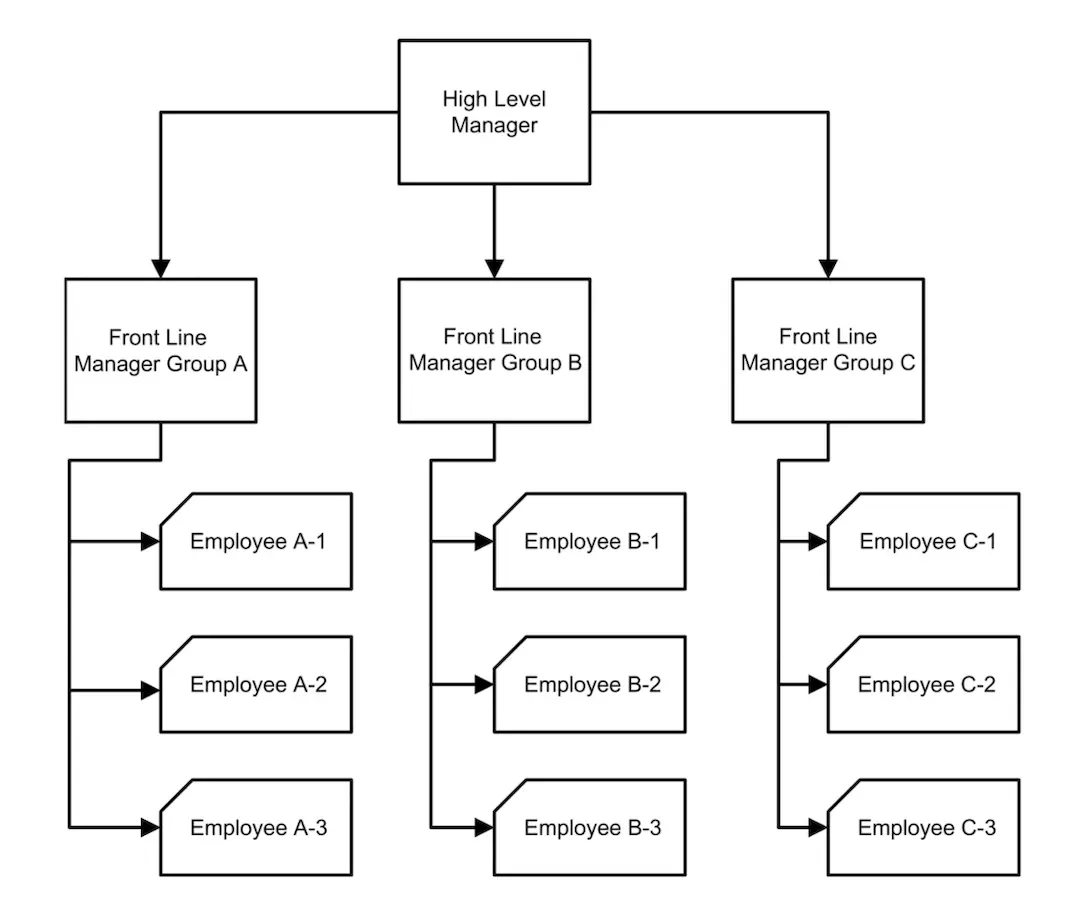 Fig. 8.21 The call tree.
Automated Call Trees
Automated call trees automatically contact all BCP/DRP team members after a disruptive event. Third-party BCP/DRP service providers may provide this service. The automated tree is populated with team members’ primary phone, cellular phone, pager, email, and/or fax.
An authorized member can activate the tree, via a phone call, email, or web transaction. Once triggered, all BCP/DRP members are automatically contacted. Systems can require positive verification of receipt of a message, such as “press 1 to acknowledge receipt.” This addresses messages answered via voice mail. Other systems may automatically join members to a conference bridge: “Press 1 to join the BCP/DRP conference.” This feature can greatly lower the time required to communicate to team members.
Automated call trees are hosted offsite, and typically supported by a third-party BCP/DRP provider. This provides additional communication protection: the third-party company is less likely to be affected by a disaster, meaning the automated call tree is likely to work even after the client organization’s communications systems have failed.
Emergency Operations Center (EOC)
The Emergency Operations Center (EOC) is the command post established during or just after an emergency event. Placement of the EOC will depend on resources that are available. For larger organizations, the EOC may be a long distance away from the physical emergency; however, protection of life and personnel safety is always of the utmost importance.